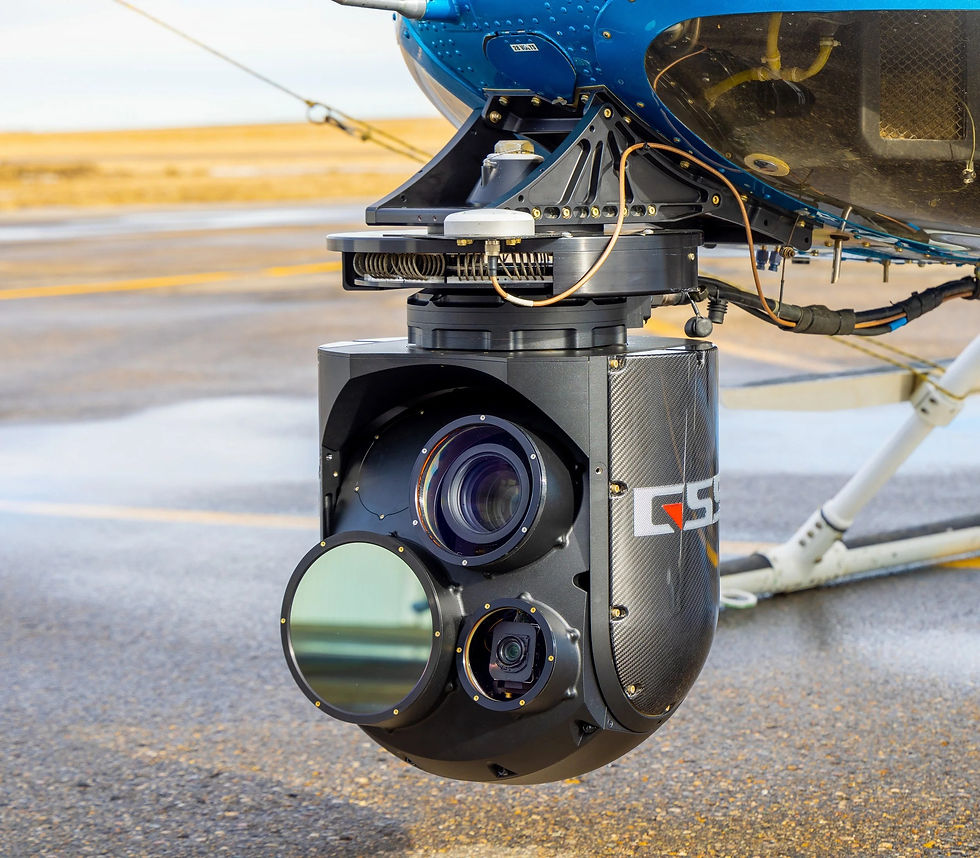
Uses for Gyro Platforms?
Gyro platforms are critical for any system that requires precise navigation, orientation, or stabilization, especially in environments where GPS or external signals are unavailable. They are widely used across aviation, marine, defense, robotics, and scientific research.
Navigation: Gyro platforms provide highly accurate data on position, velocity, and orientation. This makes them essential for aircraft, ships, submarines, and spacecraft, allowing reliable navigation even in GPS-denied areas.
Stabilization: By isolating sensors and equipment from motion, gyro platforms ensure steady operation of cameras, drones, telescopes, and weapons systems, enabling clear imaging and precise targeting.
Autonomous Vehicles & Robotics: They track movement and orientation in real-time, helping drones, self-driving cars, and industrial robots maintain stability and follow accurate paths.
Surveying & Mapping: Gyro platforms support land surveying, aerial mapping, and geophysical measurements, providing accurate orientation for instruments in motion.
Defense & Military Applications: They guide missiles, stabilise artillery and naval guns, and maintain course for submarines, delivering precision where reliability is critical.

Gyro Platforms
A gyro platform is a system that keeps equipment stable and level using gyroscopes.
Ensure precise stabilisation and control.
What is a Gyro Platform ?
Definition:
Gyroscopic stabilization is a system that is used to control and minimize the tilting movement in an unstable object. The system consists of a gyroscope which senses the tilt and orientation of the body or object. Sensing the tilt of the object the gyroscope gives then a reaction as it counter rotates by adjusting the control surface or by applying force to a gyroscope.
(Source: Medium)
Facts About Gyro Platforms
A gyro platform, often a core component of an Inertial Navigation System (INS) or Inertial Measurement Unit (IMU), is an integrated assembly engineered for high-precision applications such as navigation and stabilization. It typically combines gyroscopes, accelerometers, position sensors, and motors within a stabilized mounting structure, often using gimbals.
Key features:
-
Integrated system: Gyro platforms merge multiple sensors and mechanisms to deliver comprehensive data, including position, velocity, and attitude.
-
Actively stabilized: Unlike a simple spinning gyroscope, the platform employs motors and feedback loops to maintain a fixed orientation in space. This isolates the instruments from the motion of the vehicle, ensuring stable measurements.
-
Stable reference: The platform provides a reliable reference frame, enabling highly accurate navigation and guidance for aircraft, ships, missiles, and other vehicles where precision is critical.
-
Navigation calculations: By continuously integrating data from its gyroscopes and accelerometers, the system can compute a vehicle’s position, velocity, and orientation over time, independent of external signals such as GPS, assuming the initial position is accurately known.